Wir durchsuchen 2.047.529 Objekte für Sie.



Auction: 3 days
As of Apr 22, 2026
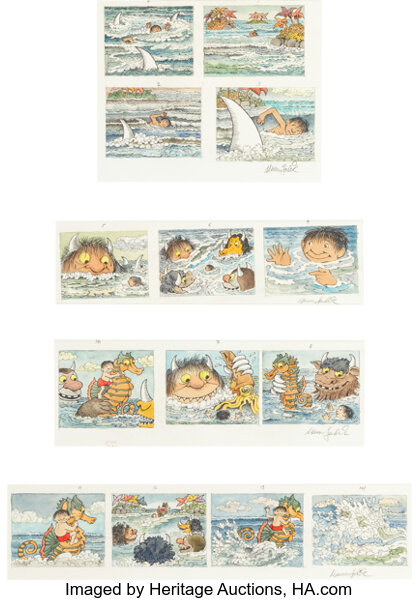
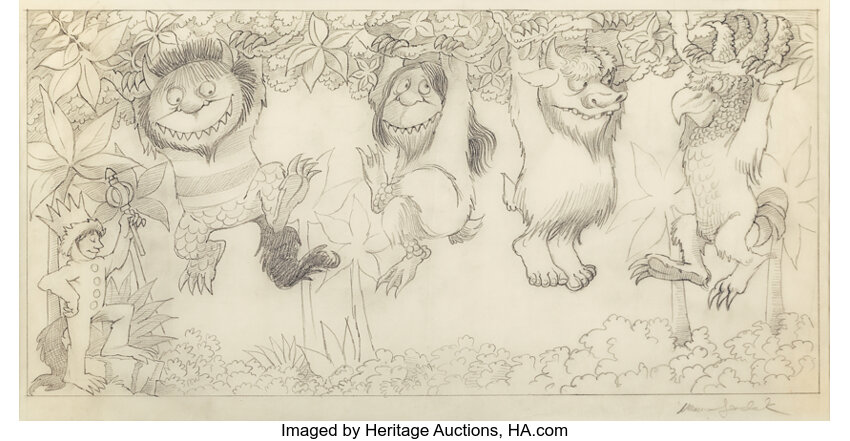
Maurice Sendak (American, 1928-2012) Wild Things are Happening: Seahorse for Bell Atlantic, 1997 Watercolor and pencil on paper, each Each approximately 2-3/8 x 3-1/2 inches (6.0 x 8.9 cm) Each signed lower right: Maurice Sendak PROVENANCE: The artist; Acquired by the present owner from the above, circa 1997. LITERATURE: J.G. Schiller, D.M.V. David, L.S. Marcus, Maurice Sendak: A Celebration of the Artist and His Work, New York, 2013, pp. 93-94, illustrated. Maurice Sendak's influence on children's literature—and on visual storytelling more broadly—cannot be overstated. Few artists have so fundamentally reshaped the emotional and psychological landscape of illustrated narrative. As scholar Selma G. Lanes observed, "In Where the Wild Things Are, Sendak not only changed forever the way picture books were perceived, but he also revolutionized their psychological depth, bridging the complex worlds of childhood fantasy and emotional truth" (The Art of Maurice Sendak, New York, 1980, p. 107). Through his fearless exploration of childhood's interior world—where imagination, fear, joy, and vulnerability coexist—Sendak secured his place as the preeminent children's illustrator of the twentieth century. His achievements were widely recognized during his lifetime, earning him the Caldecott Medal (1964), the Hans Christian Andersen International Medal (1970), and the National Medal of Arts (1996). These honors acknowledge not only his artistic brilliance, but also his willingness to confront emotional complexity with unusual candor, addressing themes of loneliness, anger, and psychological growth that had long been considered unsuitable for children's literature. The present work belongs to a fascinating and lesser-known chapter of Sendak's career: his collaboration with Bell Atlantic in the late 1990s. Commissioned to create a series of advertisements following the transformative Telecommunications Act of 1996—which ushered in a period of rapid deregulation, technological change, and consumer uncertainty—Sendak was tasked with helping to humanize a newly expanded corporate entity. The merger of NYNEX and Bell Atlantic had created one of the largest telecommunications companies in the United States, and there was concern that its scale might feel intimidating to customers navigating an increasingly complex marketplace. Sendak's solution was both ingenious and deeply characteristic: he brought his iconic Wild Things into the campaign. These creatures—once embodiments of childhood fear—were reimagined as gentle guides, reassuring figures capable of helping consumers navigate unfamiliar terrain. As one contemporary account describes: "This fourteen-panel storyboard depicts an animation sequence of a boy swimming among what appear to be sharks. Upon surfacing, however, the sharks turn out to be four Wild Things ready to assist. They present the boy with options of conveyance, and he chooses a seahorse (over a squid). He then departs on the back of a friendly hippocampus, signifying the reliability of Bell Atlantic's services" (J.G. Schiller, D.M.V. David, L.S. Marcus, Maurice Sendak: A Celebration of the Artist and His Work, New York, 2013, p. 93). These storyboard sequences—meticulously drawn and composed—function not merely as preparatory tools, but as complete works of art. Each panel reveals Sendak's mastery of pacing, gesture, and narrative progression, translating his literary sensibility into a cinematic format. The viewer is guided frame by frame through a fluid visual story, where expression and movement carry as much weight as plot. The Bell Atlantic campaign represented the most commercial deployment of the Wild Things during Sendak's lifetime, generating both widespread acclaim and some controversy among devoted admirers of his work. Yet the campaign's success was undeniable. Sendak created five print advertisements, numerous billboards, and the animated sequences for television, culminating in the appearance of a giant "Moishe" Wild Thing balloon in the Macy's Thanksgiving Day Parade. The campaign earned both an Effie Award for marketing effectiveness and a Clio Award for Sendak's print illustrations in 1998. What makes these works particularly compelling is the way they merge Sendak's deeply personal visual language with the demands of commercial communication. While serving a corporate purpose, they retain the emotional richness and imaginative vitality that define his finest book illustrations. The Wild Things, even in this adapted role, remain expressive, psychologically resonant figures—at once playful and profound. Seen within the broader arc of Sendak's career, these works expand our understanding of his practice. They demonstrate that his genius was not confined to the printed page, but extended into sequence, motion, and time itself. These storyboards offer rare insight into his creative process—how an idea unfolds, evolves, and ultimately comes to life. At once warm, inventive, and deeply human, they stand as a testament to Sendak's extraordinary ability to tell stories in any medium, reaffirming his place not only as a master illustrator, but as one of the great narrative artists of the modern era. HID12401132022 © 2026 Heritage Auctions | All Rights Reserved www.HA.com/TexasAuctioneerLicenseNotice
The artist; Acquired by the present owner from the above, circa 1997.
Condition report available upon request.