Wir durchsuchen 2.076.253 Objekte für Sie.



Auction: 19 days
As of Apr 22, 2026
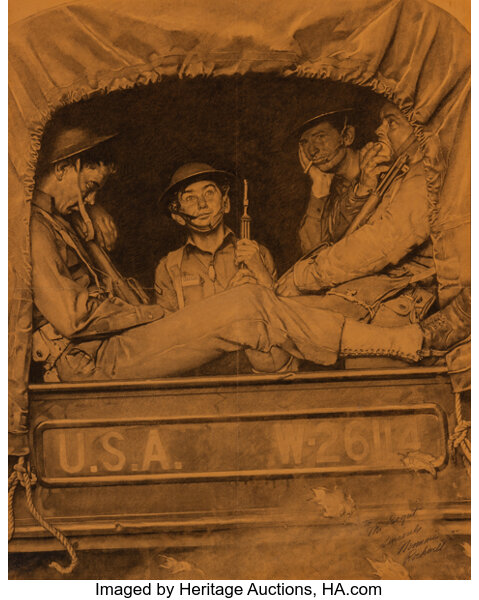
Norman Rockwell (American, 1894-1978) Willie Gillis in Convoy, circa 1943 Charcoal on paper laid on board 42 x 33-1/2 inches (106.7 x 85.1 cm) Signed and inscribed lower right: to / Mr. Bogut / sincerely / Norman / Rockwell Property from The Edward Arrigoni Collection of Illustration Art PROVENANCE: Sotheby Parke Bernet, Inc., New York, December 4, 1980, lot 238; Acquired by the present owner from the above. LITERATURE: L.N. Moffatt, Norman Rockwell: A Definitive Catalogue, Vol. II, Stockbridge, Massachusetts, 1986, p. 1107, no. M48, illustrated. The first appearance of Norman Rockwell's fictional soldier Willie Gillis debuted on the cover of The Saturday Evening Post on October 4, 1941 (fig. 1). Over the next five years, Rockwell would create eleven covers chronicling Gillis' journey through military life during World War II, crafting one of the most enduring narrative series of his career. "I had conceived of the idea of a series of Post covers depicting the army experiences of a young civilian," Rockwell later recalled, "sort of an innocent fellow who suddenly found himself caught up in a completely strange life" (N. Rockwell, My Adventures as an Illustrator, New York, 1994, pp. 326-27). Rockwell found his ideal model in Robert Otis Buck (fig. 2), a young man from Arlington, Vermont, whose open, unguarded expression embodied the innocence the artist sought. As Karal Ann Marling notes, "One Friday night, at the Grange Hall, he saw that sweet-faced, plucky innocent in the person of Robert Otis Buck... Bob Buck, age sixteen, was going to be Rockwell's everyman—everybody's son, kid brother, boyfriend, ex-paperboy. He was going to be The Saturday Evening Post's Willie Gillis, Jr." (Norman Rockwell, New York, 1997, p. 91). The character's name itself was devised by Rockwell's wife, Mary, inspired by a figure from a children's story. Through Willie Gillis, Rockwell achieved something remarkable: he humanized the American soldier at a time when the nation was grappling with the enormity of global war. Rather than depicting combat directly, Rockwell chose to focus on the emotional and psychological realities of service. "Most of the pictures I did during the war took their subjects from the civilian wartime scene—the armchair general, women war workers, the ration boards," he wrote. "That was what I knew about and what I painted best" (My Adventures as an Illustrator, p. 328). Even when the war is more present—as in Willie Gillis in Convoy—the emphasis remains on the lived experience of the individual rather than the spectacle of battle. In the present work, Rockwell situates Gillis among fellow soldiers in the back of a transport truck, moving through a dusty, unsettled landscape. The narrative unfolds through subtle but masterful detail: swirling leaves and dust at lower right signal motion, while the varied postures of the soldiers—resting, smoking, snacking, lost in thought—suggest the quiet exhaustion of travel. At the center of it all, Gillis sits upright and alert, his wide-eyed vigilance setting him apart. He is the embodiment of youthful resolve, poised between innocence and experience. Although praised by editors, Willie Gillis in Convoy was never ultimately used as a Post cover. Yet its significance within the series remains clear. As Victoria Crenson observes, "Throughout World War II... Rockwell's constant theme was home—and the ties between men in battle and the loved ones who awaited their return. The Willie Gillis covers spoke repeatedly to that bond of affection... Rockwell's serial works of the 1940s... aimed instead to convey a comforting sense of continuity" (Norman Rockwell, p. 93). In this way, Gillis became more than a character—he was a vessel through which Rockwell reassured a nation. Rockwell's ability to communicate directly and powerfully with a broad audience is central to his enduring appeal. As David Kamp writes, "Rockwell had a knack for the direct hit, the image that would connect with the widest possible audience" ("Norman Rockwell's American Dream," Vanity Fair, November 2009). The Willie Gillis series, the first sustained narrative project of its kind for the artist, demonstrates the depth of Rockwell's understanding of his cultural moment—and his ability to shape it. The present work, a large-scale, highly finished charcoal study, stands among the finest examples from the series to have come to market in recent years. It reveals Rockwell not only as a storyteller but as a draftsman of extraordinary sensitivity and control. Every gesture, every expression, is carefully calibrated to serve the narrative whole. Before the dominance of cinema, The Saturday Evening Post served as a primary source of visual storytelling for Americans. It is no coincidence that filmmakers such as George Lucas and Steven Spielberg (fig. 3) have been among Rockwell's most devoted collectors. As Spielberg himself observed, "Norman Rockwell's paintings are the movies of his time" (as quoted in Telling Stories: Norman Rockwell from the Collections of George Lucas and Steven Spielberg, Smithsonian American Art Museum, Washington, D.C., 2010). The Smithsonian American Art Museum's landmark exhibition Telling Stories: Norman Rockwell from the Collections of George Lucas and Steven Spielberg (2010–2011), which brought together fifty-seven seminal works from their private collections, explored the deep connection between Rockwell's imagery and the language of film, noting how both evoke themes of patriotism, childhood, small-town values, and the emergence of unlikely heroes. Spielberg further reflected, "Rockwell was my inspiration... He was a storyteller, and I think of myself as a storyteller too" (as quoted in Norman Rockwell: Pictures for the American People, Museum of Fine Arts, Boston, Massachusetts, 1999). Seen through this lens, the influence of Rockwell—and of Willie Gillis in particular—extends far beyond illustration, finding resonance in the cinematic imagination of modern America, most notably in Spielberg's Oscar-winning 1998 film Saving Private Ryan (fig. 4), set in Normandy in 1944, just one year after the present work was executed. In Willie Gillis in Convoy, Rockwell achieves a delicate balance between narrative clarity and emotional depth. The result is an image that is both of its time and timeless—a poignant meditation on youth, duty, and the quiet humanity at the heart of the American experience. HID12401132022 © 2026 Heritage Auctions | All Rights Reserved www.HA.com/TexasAuctioneerLicenseNotice
Sotheby Parke Bernet, Inc., New York, December 4, 1980, lot 238; Acquired by the present owner from the above.
Condition report available upon request.
Framed Dimensions 53 X 44.5 Inches




 Rockwell Kent
  Will Barnet
  Winslow Homer
  Thomas Benton
  Alfred Stieglitz
  Alfred Stieglitz