Wir durchsuchen 2.039.849 Objekte für Sie.



Auction: 5 days
As of May 18, 2026
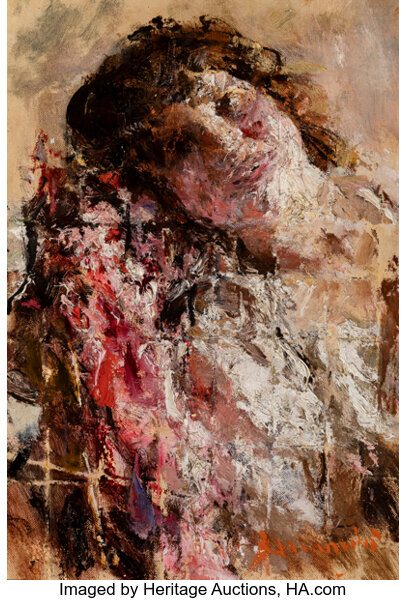
Antonio Mancini (Italian, 1852-1930) Ritratto di donna (Portrait of a woman) Oil on canvas 20 x 13-1/2 inches (50.8 x 34.3 cm) Signed lower right: A. Mancini Property from the Dr. Sheldon G. and Irma H. Gilgore Collection of Italian Art 1850-1925 PROVENANCE: Fernand du Chêne de Vère; Franco Semenzato; Knoedler Gallery, London, 1922; Galleria dell'Arte Prisma, Cuneo; Acquired from the above, 1990. EXHIBITED: Knoedler Gallery, London, 1922; Galleria dell'Arte Prisma, Cuneo, 1990; The Gilgore Collection, Naples, Florida, "A Chisel and Brush, Vincenzo Gemito, 1852-1929, Antonio Mancini, 1852-1930," 2000, no. 30. LITERATURE: C. Semenzato, La pittura italiaan dell'Ottocento, Milan, 1989, no. 228, illustrated; C. Virno, Antonio Mancini Catalogo Ragionato dell'opera, vol. 1, Rome, 2019, p. 387, no. 677, illustrated. Around 1883, Mancini adopted an intricate painting method he called graticola (meaning "grating," as in a church confessional window), which he continued to use into the 1920s. It consisted of one wooden frame with strings stretched horizontally, vertically, and sometimes diagonally across it, set in front of his subject, while a second was placed directly upon the canvas. Renaissance artists employed a similar technique when painting frescoes, squaring off an image and applying a corresponding grid onto the wall using cords dipped in pigment. However, in Mancini's work circa 1910-1920, such as Ritratto di donna, the grid system functions less as a transfer device than as a means of creating an overall structure within a composition, verging on abstraction. In the present work, the smiling woman appears to dissolve within a vibrant palette of paint applied in thick layers in the lower two-thirds of the composition, while brushy applications through the woman's hair and around her head barely cover the canvas surface. As Mancini removed the cords from the expressive paint surface, the resulting quilt-like grid became a "visual armature" to organize and stabilize what might otherwise appear incoherent. While the graticola was used throughout much of Mancini's career, its exact methodology remains elusive, as both the artist and observers struggled to define the process (A Chisel and a Brush, exh. cat., p. 94; U. W. Hiesinger, Antonio Mancini: Nineteenth-Century Italian Master, exh. cat., Philadelphia Museum of Art, 2007–2008, pp. 66–67). HID12401132022 © 2026 Heritage Auctions | All Rights Reserved www.HA.com/TexasAuctioneerLicenseNotice
Knoedler Gallery, London, 1922; Galleria dell'Arte Prisma, Cuneo, 1990; The Gilgore Collection, Naples, Florida, "A Chisel and Brush, Vincenzo Gemito, 1852-1929, Antonio Mancini, 1852-1930," 2000, no, 30.
Fernand du Chêne de Vère; Franco Semenzato; Knoedler Gallery, London, 1922; Galleria dell'Arte Prisma, Cuneo; Acquired by the present owner from the above, 1990.
Original canvas board tacked to secondary lining. Small loss lower center. Small loss and tear to original canvas board lower right. Some craquelure in areas of high impasto.
Under UV: varnish fluoresces green.
Framed Dimensions 29.5 X 23 Inches