Wir durchsuchen 2.081.313 Objekte für Sie.



Auction: 11 days
As of May 28, 2026
MATARÉ, EWALD
1887 Aachen–1965 Büderich
Title: Grasende Kuh II.
Date: 1930 (proof).
Technique: Bronze, light brown patinated.
Measurement: 15.5 x 24.5 x 10 cm.
Notation: Artist's signet centre on the plinth: Mataré (lig.).
We are grateful to Mr Guido de Werd, Cologne, for his kind academic support.
Provenance:
- - Private collection Austria
Literature:
- Schilling, Sabine Maja/Werd, Guido de: Ewald Mataré – Das plastische Werk, Werkverzeichnis, Vol. II, Cologne 2024, cat. no. 70a, ill.
- Schilling, Sabine Maja: Ewald Mataré – Das plastische Werk, Werkverzeichnis, Cologne 1987, cat. rais. no. 64a, ill.
- Animals, and cows in particular, have been the artist’s favourite subjects since 1917
- One of the finest depictions of a cow, impressive in size and perfectly executed in its abstract form
- Beautiful light brown patina
- A highly distinctive version of "Grasenden Kuh II", extremely rare
How Chance Set an Artist on His Path
“[…] in the absence of planks for woodcuts, [I] made sculptural carvings instead […]”
— Ewald Mataré, diary entry of 27 June 1922, quoted in Sabina Maja Schilling, Ewald Mataré: Das plastische Werk, Cologne, 1987, p. 27
When Ewald Mataré wrote this diary entry on Spiekeroog in 1922, he was already a fully trained painter, having completed his studies at the Berlin Academy. The son of an affluent upper-middle-class family managed to make ends meet during the economically difficult 1920s through occasional commissions and sales. For four years, he had been well connected within Berlin’s Novembergruppe (November Group). Mataré travelled extensively, particularly to the North German coast.
As early as 1920, on Wangerooge, he had conceived the idea of carving driftwood planks for woodcuts. But now, two years later, there were only pieces of wood suitable for sculptural carving. It was in this moment that Ewald Mataré discovered himself as a sculptor.
He initially carved human figures: a walking girl, a portrait head of Hanna, who would later become his wife. Soon, however, he also adopted the motif of the cow in fully sculptural carving—a subject that had fascinated him since 1917 as a painter and later as a printmaker in his woodcuts. From this point forward, animal sculpture would define the artist’s oeuvre.
Whether cow, horse, or cat, whether in wood or bronze, Ewald Mataré’s sculptures invariably invite both eye and hand to engage in touch. Years later, reflecting upon this artistic intention of the 1920s, he wrote:
“I proclaimed for myself, and beyond myself, touching, feeling, as the primary aspect of form-making, and with this insight—which I developed entirely from within myself—I stood, and still stand today, alone.”
(Ewald Mataré, diary entry of July 1947, quoted ibid., p. 27)
In Dr. Eduard Senff of Düsseldorf, Mataré found a patron and collector who enabled further travels in the years to come. Encounters with the compact, self-contained figures in Giotto’s frescoes in Italy became particularly significant for his artistic development.
In 1926, the Fritz Gurlitt Art Salon in Berlin staged Mataré’s first solo exhibition of sculpture, though initially without great success. The artist also designed and painted ceramics, among them commissions for Ludwig Mies van der Rohe; applied art would remain an integral component of his practice.
A monthly stipend from a patron, who also purchased some of his works, brought financial stability, supplemented by support from the Ministry of Culture. During the summers, Mataré travelled through the Baltic states, Denmark, and Finland.
In 1932, he abandoned his itinerant life in favour of a professorship at the Düsseldorf Academy. Yet this proved only a brief interlude: in 1933, Mataré was dismissed by the National Socialist authorities and later classified as a “degenerate” artist. Fortunately, however, he was spared both an exhibition ban and a professional prohibition.
During this difficult period, alongside occasional private sales, contact with the Catholic Church in Cologne proved a stroke of fortune. Church commissions enabled him to survive the years up to 1945. After the war, Ewald Mataré was rehabilitated and reinstated at the Düsseldorf Academy.
His craftsmanship-based, materially focused approach deeply influenced his students, among them Erwin Heerich, Georg Meistermann, and, most prominently, Joseph Beuys. In the postwar period, Ewald Mataré became one of West Germany’s leading sculptors. Numerous exhibitions and commissions from church and state testify to this status. Among his most prominent works are the four doors of the south façade of Cologne Cathedral and the doors of the World Peace Memorial Church in Hiroshima.
Mataré participated in the first two editions of the documenta exhibitions in 1955 and 1959. He died in Büderich in 1965.
“The Entire Problem of the Cow”
When the Berlin-based Ewald Mataré turned toward animal sculpture around 1920, he was not alone in focusing on this subject. Fellow artists such as August Gaul, Renée Sintenis, and Wilhelm Krieger likewise sought to unite nature and art within their sculptural work.
Mataré’s interest, however, appears to have been of a different kind. Increasingly, he abstracted the animal body until head, torso, and limbs merged into a unified whole, without ever losing connection to the natural model. Ornament played an important role in this process, representing for the artist order, internal coherence, and the expression of essentials.
As a result, his animal sculptures became increasingly reduced and emblematic—sign-like forms rather than descriptive representations. Mataré was not interested in reproducing characteristics, but rather in expressing the exemplary and primordial.
Ewald Mataré spent the summer of 1930 in southern Finland, first on Lill Pellinge and later, in July, in Sahalahti. In his diary he noted:
“[…] This time, a grazing cow. I have always somewhat avoided approaching this problem; I do not know why, since it is almost the natural state of cattle to have their heads on the ground […] Now I am approaching the entire problem of the cow […]”
(Ewald Mataré, diary entry of 30 May 1930, quoted ibid., p. 164)
Out of this inquiry emerged three sculptural solutions during this period. Geometrically speaking, the body of the animal was conceived each time as a trapezoid combined with a triangle. The line of the belly and throat forms an almost horizontal axis. Naturalistic details—such as hip bones or hooves—were omitted in favour of closed form, emblematic clarity, and tactile presence.
The Grazing Cows I–III (figs. 1–3) nevertheless differ from one another: the length of the horns, the shape of the head, the angle of the neck, and the positioning of the legs vary, giving each animal an individual “character.”
The original model for Grazing Cow II was carved by Ewald Mataré in limewood. Today, approximately twenty-five unnumbered lifetime bronze casts are known, with those mounted on rectangular plinths belonging to the later examples.
The present work possesses a particular distinction in its beautiful light-brown patina. This colouration, employed by Mataré, appears only very rarely in a handful of his sculptural creations. Equally unusual is Mataré’s decision to shorten the plinth so that the cow’s muzzle does not rest flat upon it—an uncommon feature for Grazing Cow II.
The bronze offered here is therefore a highly individual version of exceptional rarity.
Alexandra Bresges-Jung
Estimated shipping costs for this lot:
The lot is unsuitable for parcel shipping. Transport only by shipping company after consultation following the auction.
additional shipping insurance
Shipping insurance
up to total invoice amount of 25,000 Euros: max. 41.65 Euro
over a total invoice amount of 25,000 Euros: 1.8 o/oo
USA by individual arrangement after the auction.
#Ewald Mataré #Expressionism #Cubism #Germany #Modern Art #1930s #Sculptures.
In accordance with §26 UrhG (German Copyright Act), VAN HAM is obliged to pay a statutory resale royalty on the sale proceeds of all original works of fine art and photography whose authors have not been deceased for 70 years prior to the end of the calendar year of the sale. The buyer shall contribute 1.5% of the hammer price to this fee.





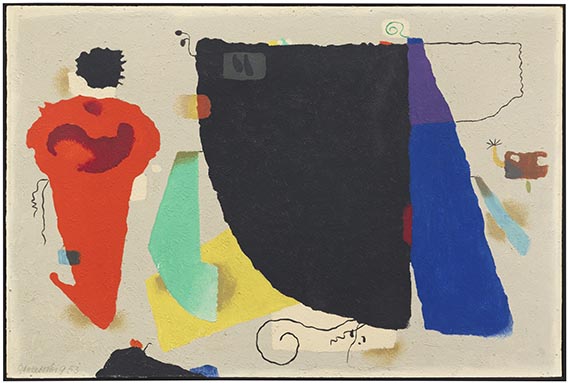
 Willi Baumeister
  Lovis Corinth
 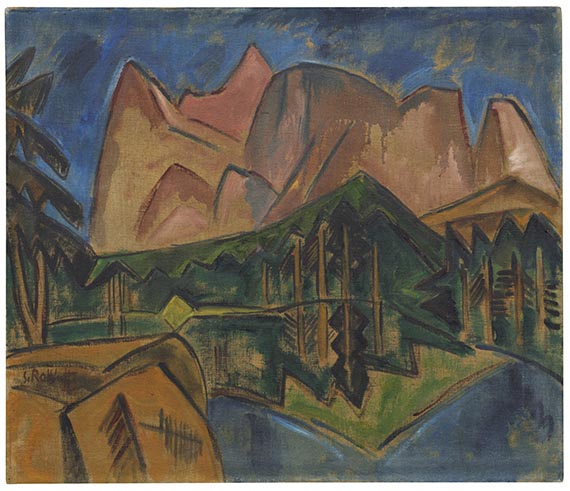 Karl Schmidt-Rottluff
 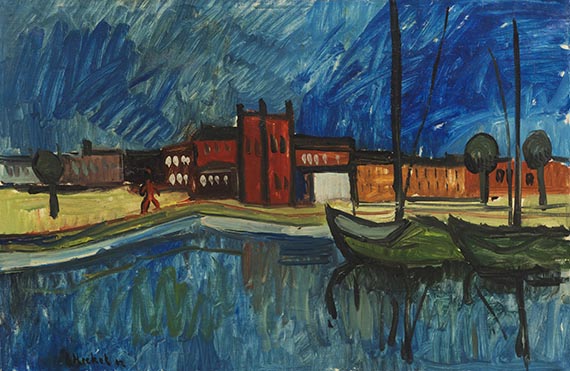 Erich Heckel
  Erich Heckel
  Karl Schmidt-Rottluff