Wir durchsuchen 2.033.047 Objekte für Sie.



Auction: 12 days
As of May 28, 2026
GÖTZ, KARL OTTO
1914 Aachen–2017 Wolfenacker
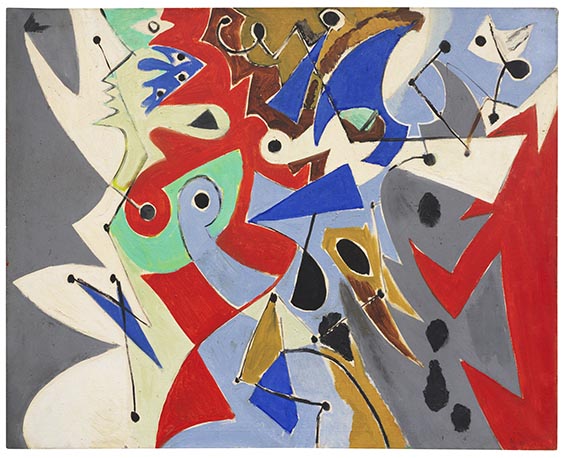
Title: "11.2.1955".
Date: 1955.
Technique: Mixed media on canvas.
Measurement: 150 x 120 cm.
Notation: Signed lower right: K. O. Götz. Verso signed and titled upper left: K. O. GÖTZ 11.2.1955. Inscribed on the stretcher: 146 Galerie CORDIER Francfort PARiS 945.
Frame: Framed.
The work is listed in the official online catalogue raisonné of paintings under catalogue number WVL-1955-05. (www.ko-goetz.de). We would like to thank Mr Joachim Lissmann, K.O. Götz and the Rissa Foundation, Niederbreitbach-Wolfenacker, for their kind academic support.
Provenance:
- - Galerie Daniel Cordier, Frankfurt/Paris
- Hauswedell & Nolte Auction House, Hamburg, 263rd Auction, 1986, Lot 319
- Private collection, North Rhine-Westphalia
Exhibition:
- Kestner-Gesellschaft, Hanover 1956 (label)
- Kölnischer Kunstverein, 1957
- Galerie Daniel Cordier, Frankfurt am Main 1959
Literature:
- Ströher, Ina: K.O. Götz – Catalogue Raisonné in two volumes, Vol. 1, 1937–1979, Cologne 2014, cat. no. 1955-5, ill.
- Exhib. cat. K. O. Götz – K. R. H. Sonderborg, Kestner-Gesellschaft, Hanover 1956, cat. no. 18
- Exhib. cat. K. O. Götz – K. R. H. Sonderborg, Kölnischer Kunstverein, 1957, cat. no. 18
- Together with Bernard Schultze, Otto Greis and Heinz Kreutz, he belongs to the Quadriga group of artists, which marks the origins of German Informel
- His working method combines dynamic, gestural painting processes with structural clarity – a tension between emotionality and rationality
- An early work of impressive scale from the main phase of Informel
A Work from a Time of Upheaval
As a pioneer of German Informel, Karl Otto Götz secured his place in the history of expressive abstract painting. The international recognition and high esteem accorded to his works by established institutions, renowned collectors, and art historians rest upon his unmistakable, dynamic, and emotionally engaging style, in which he combines formally rationalized concepts with meditative gesture.
The work presented here, dating from 1955, marks a decisive phase in his artistic development. In the immediate postwar years, Götz began his first explorations of the squeegee technique that would become characteristic of his practice. Mixing paste with paint, he applied the material to the canvas using various squeegees in a dynamic and highly expressive process. The result was calligraphic structures reminiscent of visual translations of musical frequencies or of motion blur created through long-exposure photography.
Associations with Jackson Pollock or Willem de Kooning inevitably arise through contemplative engagement with his works. This is no coincidence: Götz had encountered their art in 1951 at the groundbreaking exhibition Véhémences confrontées during one of his many stays in Paris. Held at Galerie Nina Dausset, the exhibition is regarded as a milestone in modern exhibition history.
Conceptually, Götz’s method bears similarities to Pollock’s all-over paintings. Both artists, working within the spirit of Action Painting, employed rapid, physically intensive applications of paint, often spreading their canvases across the floor. Reflecting on his own working method, Götz remarked: “I can only paint my pictures by painting them as quickly as possible.” (K.O. Götz, quoted in Heinz Althöfer (ed.), Informel – Der Anfang nach dem Ende, Museum am Ostwall, Dortmund, 1999, p. 228).
Yet unlike Pollock, Götz did not rely exclusively upon the subconscious. His works unite conscious formal control with gestural spontaneity.
A decisive milestone in establishing his oeuvre was the legendary exhibition Quadriga, which opened in 1952 at the Zimmergalerie Franck in Frankfurt am Main. Considered the first and most important exhibition of Informel in Germany, it featured works by K.O. Götz, Bernard Schultze, Otto Greis, and Heinz Kreutz.
In the years that followed, Götz held his first solo exhibitions and participated in numerous group shows in Paris, Düsseldorf, and the United States. Only a few years after his breakthrough, he was already represented at documenta II in Kassel and the 24th Venice Biennale. In 1959, he accepted a professorship at the Kunstakademie Düsseldorf, where over the course of more than two decades he played a crucial role in shaping the academy and inspired artists such as Gerhard Richter, Sigmar Polke, Gotthard Graubner, and Kuno Gonschior. It was also there that he met the artist and future wife Rissa (born Karin Martin), who became a central figure in his life and accompanied the creative processes behind his work.
Rational Dynamism
Unlike many of his contemporaries, the work of K.O. Götz retains to this day a highly distinctive style—one that is aesthetically and conceptually sophisticated, yet equally compelling. This is due above all to his powerful and dynamic handling of paint, the clarity of his compositions, and his striking chromatic choices.
The present work from 1955 embodies these characteristics and unites them in a monumental composition. Through broad zones of color unfolding alongside delicate sprays of pigment and intervening areas of empty space, and through the forceful contrast between yellow, orange, and a near-black brown, Götz intensifies both the sensation of spatiality and dynamism.
At the same time, the distribution of color across the surface is anything but arbitrary. Rather, Götz lends the work structure and clarity. Much like a calligraphic sign, the viewer is drawn into an attempt to decipher the work—to read its “script” and trace the movement of its lines. K.O. Götz speaks a language that we understand: as human beings, as viewers, and as admirers
Estimated shipping costs for this lot:
The lot is unsuitable for parcel shipping. Transport only by shipping company after consultation following the auction.
additional shipping insurance
Shipping insurance
up to total invoice amount of 25,000 Euros: max. 41.65 Euro
over a total invoice amount of 25,000 Euros: 1.8 o/oo
USA by individual arrangement after the auction.
#Karl Otto Götz #Informel #CoBrA #Germany #Post-War Art #1950s #Post War.
In accordance with §26 UrhG (German Copyright Act), VAN HAM is obliged to pay a statutory resale royalty on the sale proceeds of all original works of fine art and photography whose authors have not been deceased for 70 years prior to the end of the calendar year of the sale. The buyer shall contribute 1.5% of the hammer price to this fee.




 Ernst Wilhelm Nay
  Willi Baumeister
  Ernst Wilhelm Nay
  Ernst Wilhelm Nay
  Ernst Wilhelm Nay
  Antoni Tàpies