Wir durchsuchen 2.036.705 Objekte für Sie.



Auction: 12 days
As of May 28, 2026
TÀPIES, ANTONI
1923 Barcelona–2012 Barcelona
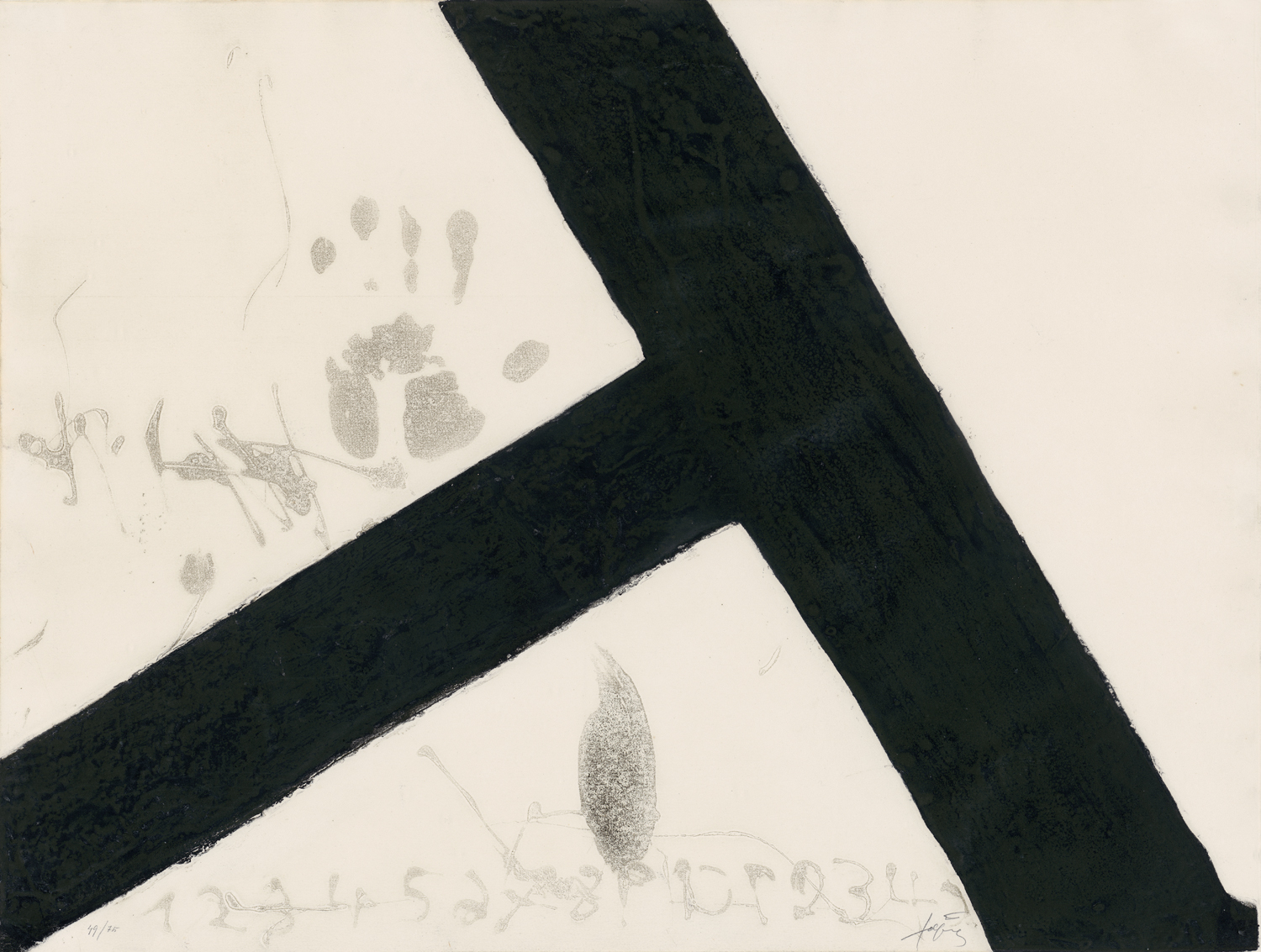
Title: "Noir avec quatre encoches".
Date: 1961.
Technique: Oil, sand and mixed media on canvas.
Measurement: 89 x 130 cm.
Notation: Signed and dated verso upper left: Tapies – 1961. Signed, dated and titled verso on the stretcher upper centre: TAPIES 1961 "NOIR AVEC QUATRE ENCOCHES".
The work is accompanied by a certificate of authenticity from the Tàpies Foundation, Barcelona, dated 30.62014. It is registered there under photograph number T 9644.
Provenance:
- - Galerie Stadler, Paris
- Private collection, Madrid
- Private collection, Milan
- Corporate collection, Italy
Exhibition:
- Kestner Gesellschaft, Hanover 1962 (remains of a label)
- Kunsthaus Zürich, 1962
Literature:
- Agustí, Anna: Tàpies – The Complete Works, Vol. 2, 1961–1968, Barcelona 1990, WVZ no. 989, ill.
- Exhibition catalogue: Antonio Tàpies, Kestner Gesellschaft, Hanover 1962, cat. no. 86
- Exhibition catalogue: Antonio Tàpies, Kunsthaus Zürich, 1962, cat. no. 88
- A powerful work whose substantial weight refers to the materiality of existence
- By the significant, pioneering Spanish artist and key representative of the Informel movement
- In the 1960s, Tàpies developed his ‘material painting’ and, with it, his unique visual language straddling abstraction and spirituality
- His scarred, wall-like canvases reflect his engagement with themes such as existentialism and resistance
Tàpies’ Worldview
The Catalan painter, printmaker, and sculptor Antoni Tàpies is regarded as the foremost representative of Informel in Spain. As a self-taught artist, Tàpies recognized early on the meaning-making power of drawing and painting. Equally formative was his engagement with philosophy—above all with the existentialism of Jean-Paul Sartre, which profoundly shaped his worldview. Like Sartre, Tàpies believed that human beings are not born fully formed but rather become who they are.
Over the course of his artistic development, Tàpies was influenced by literary and artistic models, including Surrealism and contemporary Catalan poets. In response to the political circumstances of his homeland, he adopted an activist stance in opposition to the fascism of Francisco Franco.
From Surrealism to an Earthbound Realism
During a stay in Paris in 1950, Tàpies turned toward Informel painting and the naïve, anti-academic aesthetics of Art Brut. He subsequently reduced his expressive means and increasingly concentrated on the essentials of artistic creation.
In search of an unmediated form of expression preserved in its raw state, he began experimenting with everyday objects and found materials such as used paper, string, wire, and clothing, later incorporating furniture into his paintings as well. To shape the tactile surfaces of these material works, he mixed sand, stone dust, plaster, and clay into his pigments. This dense, viscous substance—haute pâte—gave his works their thick, crust-like texture.
Through this mode of painting with non-painterly means, whose aesthetic often evokes dirt, erosion, and decay, Tàpies sought to comprehend reality itself. Against the backdrop of his experiences during the Spanish Civil War, he did not regard himself as an abstract artist but rather as a profound realist.
Matter as an Authentic Vehicle of Expression
In keeping with his profound engagement with existential questions, Tàpies understood earthy, fissured material as an authentic bearer of expression and a medium of insight through which access to the world becomes possible.
According to the artist himself, his thoughts emerged from the inherent qualities of materials, which offered essential impulses for his artistic process. Engagement with matter released ideas and sensations of its own. Thus, artistic intention and material resistance entered into a dynamic equilibrium.
Tàpies developed a concrete corporeality of the image closely connected both to the physical reality of the human body and to Buddhist and mystical conceptions of existence.
Physical Presence and Patina
The physical presence of material also dominates the present work. The heavy surface, composed of layered oil and sand, is interrupted by four incisions that function like corner points marking a central field within the painting.
Although Tàpies consistently strove for simplicity of expression, from the 1960s onward he increasingly introduced symbolic elements such as letters, numbers, and signs into the material language of his works. The present piece likewise combines the massive force of matter with traces that both claim symbolic meaning extending beyond the image and simultaneously refer back to the painting’s immediate reality—its physical manipulation by the artist.
Tàpies fundamentally rejected the use of color for its own sake. Instead, he employed it to create patina and evoke processes of natural weathering.
Primordial Matter and the Symbol of Eternity
Tàpies’ fascination with walls and stone manifests itself especially powerfully in this work. As a child, he carefully observed the scratched and inscribed walls of Barcelona’s alleyways; later, he turned his attention to painting on stone, ranging from graffiti to frescoes.
At the same time, Tàpies revered stone as a primordial geological substance pointing toward cosmic relationships. Through restrained accentuation, the symbolic force of the material unfolds through its potency as both an original and eternal substance.
Bettina Haiss
Estimated shipping costs for this lot:
The lot is unsuitable for parcel shipping. Transport only by shipping company after consultation following the auction.
additional shipping insurance
Shipping insurance
up to total invoice amount of 25,000 Euros: max. 41.65 Euro
over a total invoice amount of 25,000 Euros: 1.8 o/oo
USA by individual arrangement after the auction.
#Antoni Tàpies #Informel #Spain #Post-War Art #Painting #Abstract #1960s #Post War.
This lot will be sold under standard taxation (Condition of Sale §V5.1)
In accordance with §26 UrhG (German Copyright Act), VAN HAM is obliged to pay a statutory resale royalty on the sale proceeds of all original works of fine art and photography whose authors have not been deceased for 70 years prior to the end of the calendar year of the sale. The buyer shall contribute 1.5% of the hammer price to this fee.

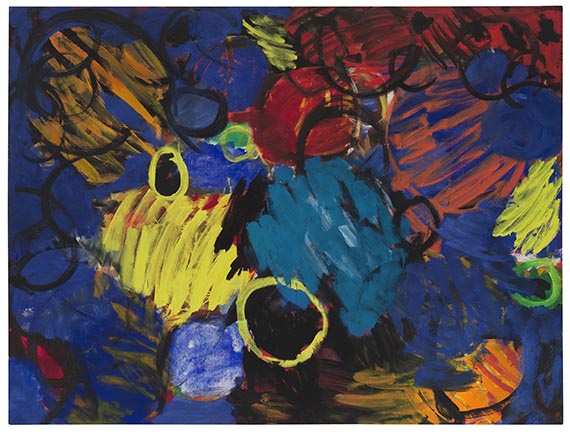


 Ernst Wilhelm Nay
 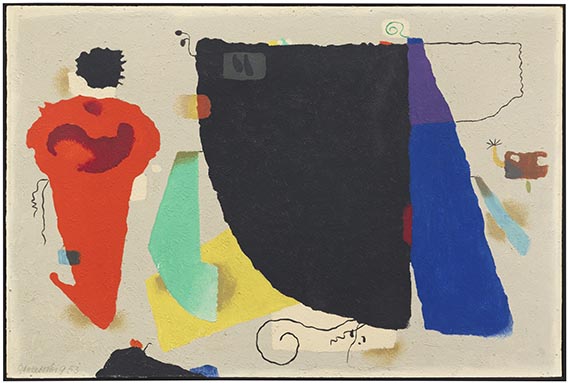 Willi Baumeister
  Ernst Wilhelm Nay
  Ernst Wilhelm Nay
  Ernst Wilhelm Nay
  Pierre Soulages