Wir durchsuchen 2.091.528 Objekte für Sie.



Auction: 12 days
As of May 28, 2026
SCHUMACHER, EMIL
1912 Hagen–1999 San José/Ibiza
Title: "Horeb".
Date: 1972.
Technique: Oil on canvas.
Depiction Size: 100 x 141 cm.
Notation: Signed and dated lower left: Schumacher 72. Verso signed, dated and titled at the top of the stretcher: Schumacher 1972 Title: HOREB. Here also provided with work details.
Frame: Framed.
The painting is listed under inventory number 0/339 in the catalogue of the Emil Schumacher Foundation compiled by Dr Ulrich Schumacher. We would like to thank Mr Rouven Lotz, Director of the Emil Schumacher Museum in Hagen, for his kind academic support.
Provenance:
- - Galerie Veith Turske, Cologne
- Private collection North Rhine-Westphalia (acquired from the previous owner in 1976)
Exhibition:
- Karl Ernst Osthaus Museum, Hagen, 1975
- Neue Galerie, Linz, 1976
- Galerie Veit Turske, Cologne, 1976/77
- Kunstverein Braunschweig, 1978
- From the artist’s mature creative period, during which he developed his informal visual language to a particularly intense level
- An extraordinarily fascinating, sculptural presence in the room – straddling the boundary between painting and sculpture
- In the family’s possession for 50 years
Emil Schumacher and German Informel
Emil Schumacher ranks among the most important representatives of postwar European painting and, as a central figure of German Informel, played a decisive role in shaping the development of abstract art. Born in Hagen in 1912, Schumacher developed after 1945 a distinctive visual language in which color, material, and brushwork merge into an immediate, almost existential mode of expression.
His works do not emerge from predetermined concepts but rather through a process-oriented, often intuitive approach that places the act of painting itself at the center. International exhibitions—including multiple participations in the documenta in Kassel—brought his work early international recognition and firmly secured his place within the canon of postwar art.
Characteristic of Schumacher’s painting is his intense, almost physical engagement with the canvas, in which the surface becomes the true bearer of artistic expression and the boundary between image and object increasingly dissolves.
Materiality and Expression in Horeb
The painting Horeb, created in 1972, stands as an impressive example of this characteristic working method. The composition is dominated by a massive, dark field of paint that stretches heavily and almost impenetrably across the pictorial surface. Through impasto, relief-like structures, Schumacher compresses pigment into an almost sculptural surface.
The torn and partially blackened layers of material reveal traces of the painterly process, lending the work a strong physical presence. Scratching, layering, overlapping—all of these interventions remain inscribed within the painting and testify to an intense confrontation with material itself.
At the center, a luminous turquoise field opens up like an inner pictorial space, forming a striking contrast to the surrounding darkness. This tension between density and openness, between luminosity and weight, belongs to Schumacher’s essential compositional devices. Color here functions not merely as a visual element, but as substance—possessing weight, resistance, and depth. It is precisely in this union of painterly gesture and material presence that the work derives its particular power.
Between Archaic Landscape and Inner Eruption
The title Horeb, named after the biblical mountain of God, intensifies the composition’s suggestive effect. It opens a field of associations without prescribing any singular interpretation. The work may be understood both as an imagined, archaic landscape and as the expression of an eruptive inner movement.
In this openness, Schumacher combines elemental force with a quiet, almost meditative quality. Exposed sections of canvas along the edges stand in deliberate contrast to the dense materiality at the center, generating a charged spatial dynamic that repeatedly redirects the viewer’s gaze.
With its forceful and corporeal pictorial structure, Horeb stands as an exemplary work of Emil Schumacher’s mature period in the early 1970s—a time in which the artist brought his Informel visual language to a particular level of intensity
Estimated shipping costs for this lot:
The lot is unsuitable for parcel shipping. Transport only by shipping company after consultation following the auction.
additional shipping insurance
Shipping insurance
up to total invoice amount of 25,000 Euros: max. 41.65 Euro
over a total invoice amount of 25,000 Euros: 1.8 o/oo
USA by individual arrangement after the auction.
#Emil Schumacher #Informel #Germany #Post-War Art #Painting #Abstract #Oil #1970s #Post War.
In accordance with §26 UrhG (German Copyright Act), VAN HAM is obliged to pay a statutory resale royalty on the sale proceeds of all original works of fine art and photography whose authors have not been deceased for 70 years prior to the end of the calendar year of the sale. The buyer shall contribute 1.5% of the hammer price to this fee.




 Cy Twombly
  Morris Louis
 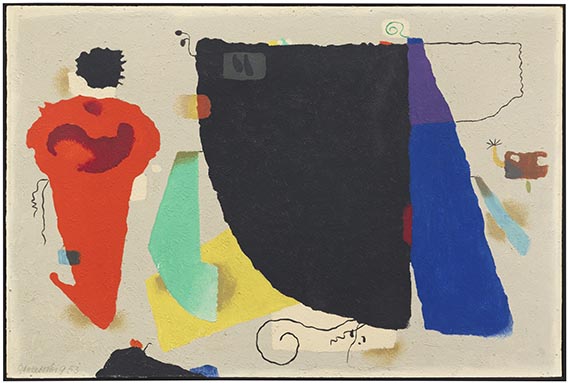 Willi Baumeister
 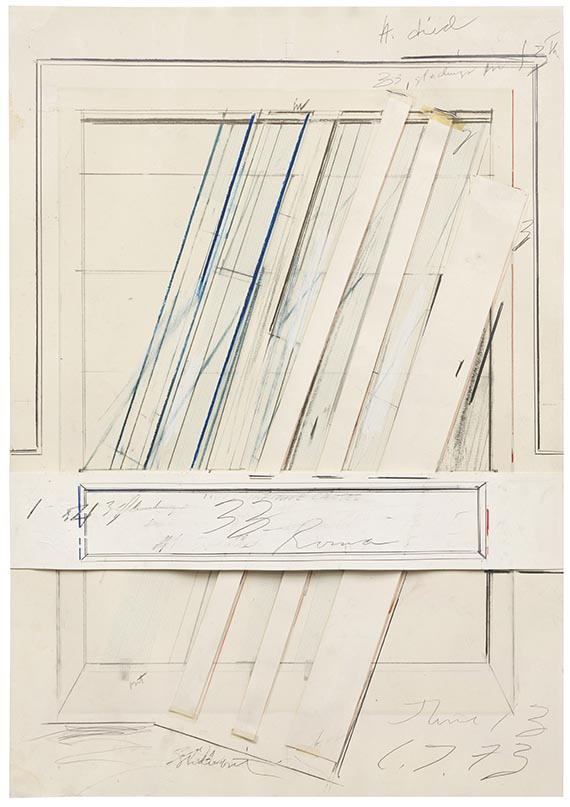 Cy Twombly
 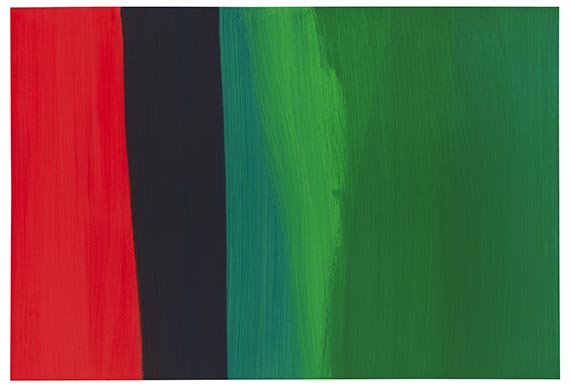 Katharina Grosse
 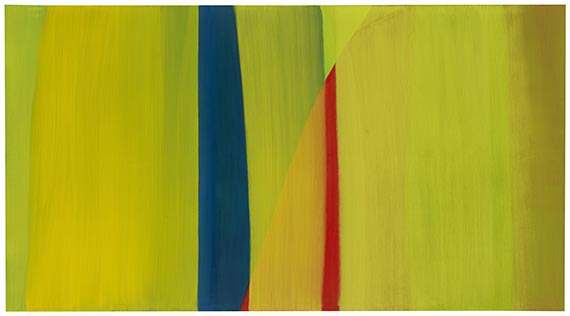 Katharina Grosse