Wir durchsuchen 2.077.918 Objekte für Sie.



Auction: 12 days
As of May 28, 2026
MACKE, AUGUST
1887 Meschede–1914 Perthes-les-Hurlus
Title: "Composition II" (Susanna in the bath).
Date: 1913.
Technique: Watercolour and India ink on drawing paper.
Measurement: 23.5 x 25 cm.
Notation: Inscribed, dated and titled verso bottom: Farbige Tusche Composition II 1913. Here additionally with the estate stamp of the artist (Lugt 1775b) with the registered number 29.
Frame: Craftsman's frame.
Provenance:
- - Dr. Fischer Collection, Stuttgart
- Stuttgarter Kunstkabinett Roman Norbert Ketterer, auction 29.11.1955, lot 1622
- Dallinger collection
- Walter Bareiss collection, New York
- Museum of Modern Art, New York (gift W. Bareiss, 1957)
- Private collection South America/Germany
Exhibition:
- Städtisches Kunsthaus Bielefeld, 1957
- Sala de Exposiciones Fundacion Eugenio Mendoza, Caracas 1959
Literature:
- Heiderich, Ursula: August Macke - Aquarelle, Werkverzeichnis, Ostfildern-Ruit 1997, cat. rais. no. 108, ill.
- Vriesen, Gustav: August Macke, Stuttgart 1957 (2nd ed.), cat. no.115, ill.
- Exhib. cat.. Macke. Aquarell-Ausstellung, Städtisches Kunsthaus Bielefeld, 1957, cat. no. 115, ill. p. 20
- Exhib. cat. Expressionismo in Alemania, Sala de Exposiciones Fundacion Eugenio Mendoza, Caracas 1959, cat. no.. 68
- August Macke: mental and artistic centre of the Rhinish Expressionists, member of the Blauer Reiter
- Classical image theme in a radically modern interpretation
- Harmonious composition with vibrant colours
August Macke is regarded as a precocious artist of German Expressionism and the epitome of a style of painting that combines joie de vivre, colour and modernity. As a member of the legendary artists’ group ‘Der Blaue Reiter’ and the intellectual linchpin of the Rhenish Expressionists, he was at the heart of an era that reinvented the way we see and paint. Influenced by the French avant-garde – he travelled to Paris in 1907, 1908 and 1912 – Macke developed his own distinctive visual language. His paintings continue to fascinate today with their colourful lightness, transforming the everyday into the poetic: people strolling, brightly lit shop windows, harmonious landscapes and still lifes. Although his life came to a tragically early end on the battlefields of the First World War, August Macke left behind a significant body of work of timeless radiance, which impressively attests to his central role in the development of modern painting.
In 1911, August Macke found himself at a pivotal point in his development. Early the previous year, he had met Franz Marc in Munich, with whom he shared an artistically inspiring and supportive friendship: in November, he and his family had returned from an extended stay at Lake Tegernsee to his hometown
Bonn, where his studio was being extended during the winter months. During this phase of his artistic career, Macke’s interest lay in the further development of painterly techniques through traditional pictorial themes. His paintings were no longer mere representations of nature; rather, what he saw coalesced into a decorative, expressive style of painting, whose compelling visual impact arose from the absence of spatial representation and the dynamic interplay of coloured surfaces.
Macke’s watercolour of ‘Susanna at Her Bath’ occupies a special place within his oeuvre as a traditional biblical motif. The starting point is the story of the chaste Susanna from the Book of Daniel, who is secretly observed by two elders whilst bathing and later wrongly accused of infidelity. At the centre of Macke’s composition lies a naked female figure on a pink cloth, surrounded by luminous shades of blue of varying intensity and depth, which create an atmosphere of water, light and movement. Behind her, the faces of two elderly men appear as silhouettes, gazing from their hiding places at the young woman’s exposed body. In contrast to the traditional depiction of ‘Susanna at the Bath’, Macke is less interested in the narrative or moral dimension of the subject matter, but rather uses the motif as an opportunity for a formal exploration of the interplay between colour, surface and figure. The female figure is not primarily an object of voyeuristic observation, but part of a compositional harmony, embedded in a network of brightly coloured flat forms. In doing so, Macke removes the subject from its traditional context and translates it into the language of Modernism
Estimated shipping costs for this lot:
The lot is unsuitable for parcel shipping. Transport only by shipping company after consultation following the auction.
additional shipping insurance
Shipping insurance
up to total invoice amount of 25,000 Euros: max. 41.65 Euro
over a total invoice amount of 25,000 Euros: 1.8 o/oo
USA by individual arrangement after the auction.
#August Macke #Expressionism #Germany #Modern Art #1910s #Modern Art.





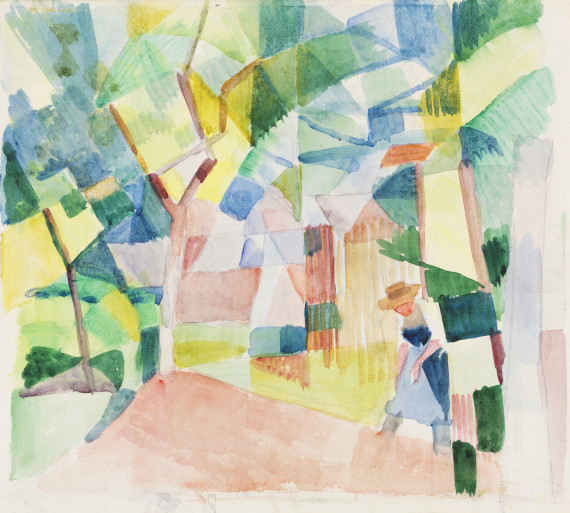
 August Macke
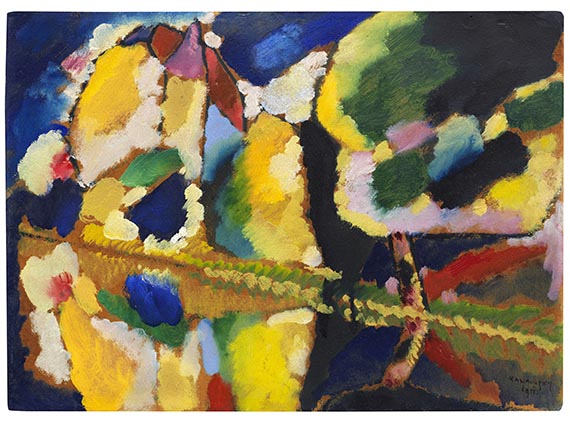 Wassily Kandinsky
 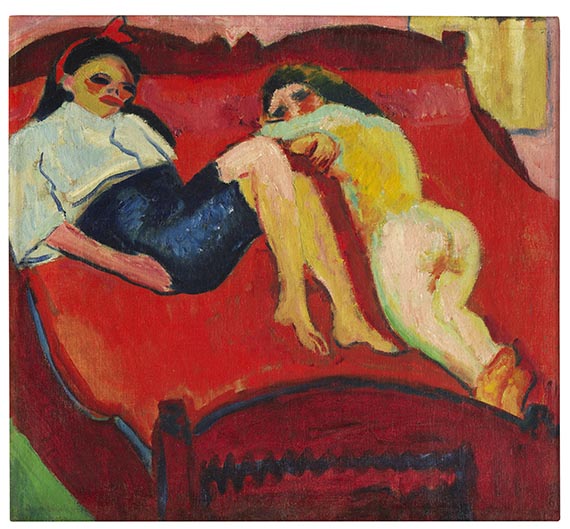 Hermann Max Pechstein
  Francis Picabia
  Ernst Ludwig Kirchner
  Emil Nolde
  Lyonel Feininger