Wir durchsuchen 2.047.091 Objekte für Sie.



Auction: 4 days
As of Apr 22, 2026
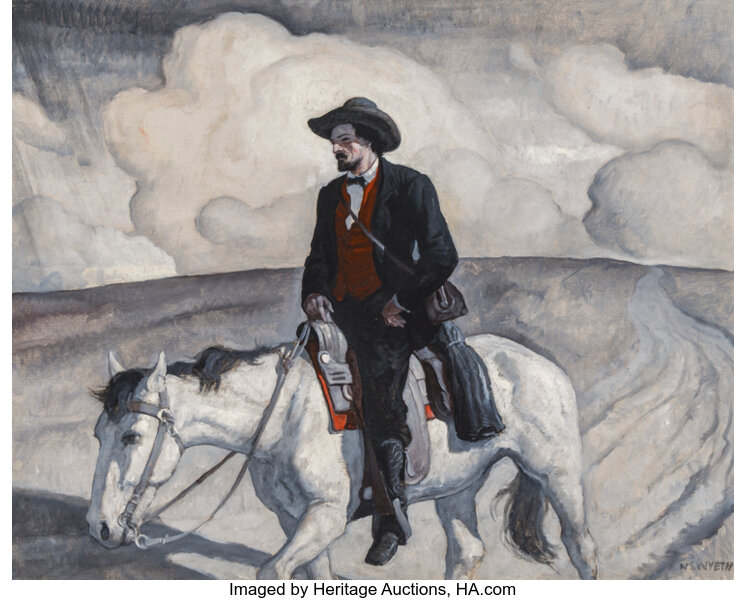
Newell Convers Wyeth (American, 1882-1945) "Doctor Valliant Often Vanished for Days and Would Reappear as Inexplicably as He Had Vanished," Woman's Home Companion interior illustration, 1929 Oil on canvas 32 x 40 inches (81.3 x 101.6 cm) Signed lower right: NC WYETH PROVENANCE: The artist; Barbara Pyle Barriner, granddaughter of Howard Pyle, possible wedding gift from the above; Brock Parker, New York, acquired from the above; By descent to the present owner. LITERATURE: E. Ferber, "Cimarron," Woman's Home Companion 5, no. 2, February 1930, p. 29, illustrated; D. Allen, D. Allen, Jr., N.C. Wyeth: The Collected Paintings, Illustrations, and Murals, New York, 1972, p. 279; C. Podmaniczky, N.C. Wyeth: A Catalogue of Raisonné of Paintings, Vol. II, London, 2008, p. 526, no. I.1136, illustrated. N.C. Wyeth stands among the most formidable illustrators of the Golden Age, an artist whose work transcended the boundaries of commercial art to achieve the scale, ambition, and emotional resonance of history painting. His illustrations for major American periodicals—including Woman's Home Companion—represent some of the most sophisticated narrative images produced in early 20th-century American art. The present work was created for Edna Ferber's Cimarron, a sweeping novel of the American frontier that captured the spirit of expansion, hardship, and transformation in the American West. First serialized in Woman's Home Companion before its publication as a novel in 1930, Cimarron offered Wyeth a rich narrative terrain well suited to his strengths: drama, character, and atmosphere. His illustrations for the story are among his most evocative Western images, capturing not only the physical landscape but also the psychological complexity of its inhabitants. The subject depicted here—Doctor Valliant, a mysterious and elusive figure—embodies the rugged individualism and quiet enigma that define Ferber's narrative. As the accompanying text suggests, Valliant "often vanished for days and would reappear as inexplicably as he had vanished," a quality that Wyeth translates visually through the composition's mood and restraint. Mounted on horseback against a vast, open terrain, the figure is both present and remote—grounded in the landscape yet psychologically distant. Wyeth's handling of the scene is masterful. Unlike the high-keyed color often associated with his work, he adopts a restrained, near-monochromatic palette with just touches of red, heightening the sense of isolation and introspection. The rolling expanse behind the figure is rendered with subtle tonal shifts, while the towering cloud formations lend a sense of quiet grandeur. The horse, painted with characteristic authority, anchors the composition, while the figure of Valliant—slightly turned, introspective—remains the emotional focal point. What stands out is the shared ease of both rider and horse: Dr. Valliant’s hands rest loosely on the horse’s neck rather than the reins, which hang slack as the animal carries its head low. His relaxed posture and the gentle swish of the tail convey a quiet rhythm—an interplay of fatigue and calm. The result is an image that feels less like a moment of action and more like a psychological portrait set within the vastness of the American West. This ability to balance narrative clarity with emotional depth is central to Wyeth's achievement as an illustrator. Trained under Howard Pyle, Wyeth inherited a belief that illustration should aspire to the highest standards of fine art. He carried that philosophy forward, producing works that were not merely descriptive, but immersive—images that invite the viewer to inhabit the story. His illustrations for Woman's Home Companion exemplify this approach, combining technical virtuosity with a profound sensitivity to character and setting. The provenance of the present work adds a remarkable and deeply personal dimension to its significance. It is believed that the painting was gifted by Wyeth himself to Barbara Pyle Barriner, the granddaughter of his teacher and mentor, Howard Pyle. Such a gesture speaks to the continuity of artistic lineage between Pyle and Wyeth, and to the close personal relationships that defined this circle of illustrators. The work has remained out of public view for decades and, until now, was known only through photographic reproduction. Its appearance here marks the first time it has been offered for sale. Executed in 1929, at the height of Wyeth's career, this painting exemplifies the qualities that define his greatest work: compositional strength, narrative intelligence, and a profound engagement with the American landscape. It is both an illustration and something more—a work that stands comfortably within the broader tradition of American painting. In Doctor Valliant, Wyeth demonstrates not only his mastery of storytelling, but his ability to elevate that story into a timeless image—one that captures the mystery, solitude, and enduring mythology of the American West. HID12401132022 © 2026 Heritage Auctions | All Rights Reserved www.HA.com/TexasAuctioneerLicenseNotice
The artist; Barbara Pyle Barriner, granddaughter of Howard Pyle, possible wedding gift from the above; Brock Parker, New York, acquired from the above; By descent to the present owner.
Condition report available upon request.
Framed Dimensions 34 X 42 Inches