Wir durchsuchen 2.075.910 Objekte für Sie.



Auction: 12 days
As of May 28, 2026
NAY, ERNST WILHELM
1902 Berlin–1968 Cologne
Title: "Rot-Grün mit gelber Kette".
Date: 1966.
Technique: Oil on canvas.
Measurement: 110 x 100 cm.
Notation: Signed and dated lower right: Nay 66. Signed, titled and dated verso upper on the stretcher: NAY – 'Rot-Grün mit gelber Kette' 1966.
Frame: Craftsman's frame.
We are grateful to the Ernst Wilhelm Nay Foundation, Cologne, for its generous academic support.
Provenance:
- - Christoph Scheibler Collection, Cologne
- Private collection, North Rhine-Westphalia
Exhibition:
- Galerie Der Spiegel, Cologne 1967
Literature:
- Ernst Wilhelm Nay Foundation (ed.): Catalogue Raisonné – *www.nay.aps-info.de*, cat. rais. no. WV-S 1186
- Scheibler, Aurel: Ernst Wilhelm Nay – Werkverzeichnis der Ölgemälde, Vol. II 1952–1968, Cologne 1990, cat. rais. no. 1186, ill.
- Reiser, Walter: Begegnung. Maler und Bildhauer der Gegenwart / Encounters. Contemporary Artists and Sculptors, Stuttgart 1970, ill. n.p.
- From the phase of his extremely popular „Späten Bilder“
- Clear colours and reduced, condensed forms lend the work immense power and tension
- From the artist’s estate and in private ownership ever since
Colour – Surface – Form – Rhythm: Nay’s “Late Paintings”
Ernst Wilhelm Nay devoted his life to painting with extraordinary intensity and productivity, developing a number of clearly distinguishable artistic phases. Throughout, however, he remained an exceptional colourist, deeply interested in pictorial surface and endowed with a powerful sense of dynamism and rhythm. These characteristics unite the highly diverse works produced over five decades and continually reveal the artist’s unmistakable personality.
In the winter of 1964/65, Ernst Wilhelm Nay reinvented his painting once again. Since the early 1950s, his art had already become largely non-representational through the Rhythmic Paintings, the Disc Paintings, and the Eye Paintings. In the Late Paintings that now emerged, the painter appears to push this development even further.
Across often nearly square canvases, Nay arranged colourful forms in vertical sequences across flattened pictorial space. More fluid paint largely conceals individual brushwork and painterly gesture. In their contourless, separated flatness, the forms occasionally resemble collaged stencils, evoking associations with the very late works of Henri Matisse.
Dynamism Meets Stasis
The present painting belongs to this late body of work. The right third of the canvas is dominated by static vertical elements: a cool, lemon-yellow chain-like structure stands beside a simpler, warm yellow, elongated baluster form. Both yellow motifs seem capable of extending conceptually beyond the limits of the pictorial field. The white behind them consists largely of untreated, unprimed canvas.
From the left, however, a red force presses into the remaining pictorial space, here formed by dark bottle green streaked with white veils. Yet the red “elliptical thing,” equipped with tentacle-like barbed extensions, relentlessly expands. It compresses the white amorphous forms, pressing them toward the yellow baluster. For now, the static barrier still holds.
There are several possible approaches to the non-representational late paintings of Ernst Wilhelm Nay. One interpretation sees the coloured forms as dramatically enlarged structures drawn from the (cellular) microcosm of nature.
The art historian Werner Haftmann, Nay’s long-time companion, friend, and author of his first monograph, emphasized in this regard:
“‘Nature’ is not merely the tiny point of the visible; it is also the formula of mathematics, the entire intangible background against which humanity today has established its existence, and from which—if he is a painter—a person creates an image as an analogy to that ‘nature.’”
(Werner Haftmann, quoted in exhibition catalogue E. W. Nay (1902–1968), Cologne/Berlin/Frankfurt/Hamburg, 1969, p. 11)
The Theorist with Practical Consequences
The catalogue raisonné of Ernst Wilhelm Nay also includes the painting Grünklang (Green Resonance, cat. raisonné no. S 1184, fig. 1), which appears as a variation on the theme of the present painting, distinguished by altered colouration on the right-hand side and consequently a different overall mood.
In 1955, the painter—who, apart from a brief interlude, never worked as an academy professor but nevertheless articulated his own artistic theories—published his manifesto-like essay On the Formal Value of Colour (Vom Gestaltwert der Farbe). The ideas set forth there may provide an important point of access to the Late Paintings created a decade later.
From today’s perspective, however, it seems equally valid simply to experience and sustain the immense energy and tension that Ernst Wilhelm Nay brought to Red-Green with Yellow Chain (Rot-Grün mit gelber Kette) through colour and form alone.
The confrontation between two profoundly different systems—chaos on the left and order on the right—remains held in equilibrium. Yet prolonged, meditative engagement with the work may well produce the “consciousness-expanding” effects the artist intended.
Alexandra Bresges-Jung
Estimated shipping costs for this lot:
The lot is unsuitable for parcel shipping. Transport only by shipping company after consultation following the auction.
additional shipping insurance
Shipping insurance
up to total invoice amount of 25,000 Euros: max. 41.65 Euro
over a total invoice amount of 25,000 Euros: 1.8 o/oo
USA by individual arrangement after the auction.
#Ernst Wilhelm Nay #Expressionism #Abstraction #Germany #Post-War Art #Painting #Abstract #Oil #1960s #Post War.
In accordance with §26 UrhG (German Copyright Act), VAN HAM is obliged to pay a statutory resale royalty on the sale proceeds of all original works of fine art and photography whose authors have not been deceased for 70 years prior to the end of the calendar year of the sale. The buyer shall contribute 1.5% of the hammer price to this fee.





 Ernst Wilhelm Nay
  Ernst Wilhelm Nay
 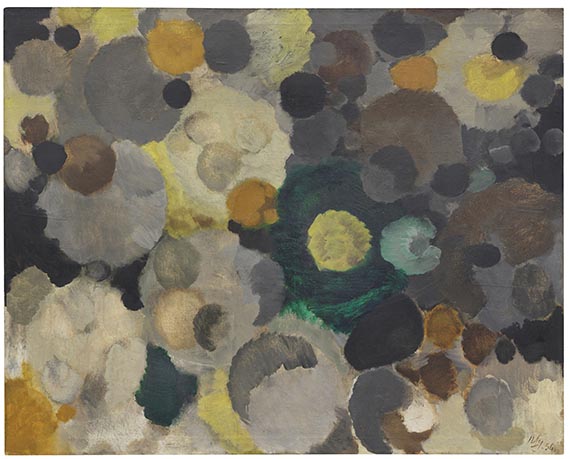 Ernst Wilhelm Nay
 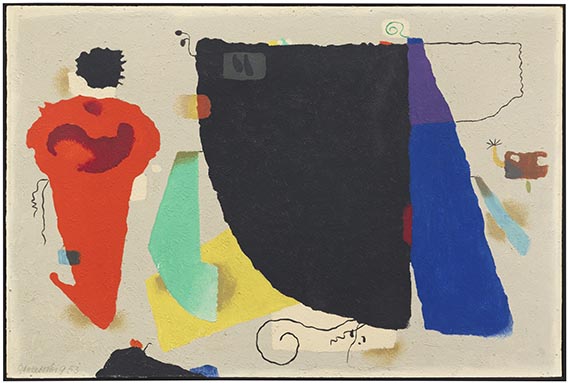 Willi Baumeister
  Antoni Tàpies
 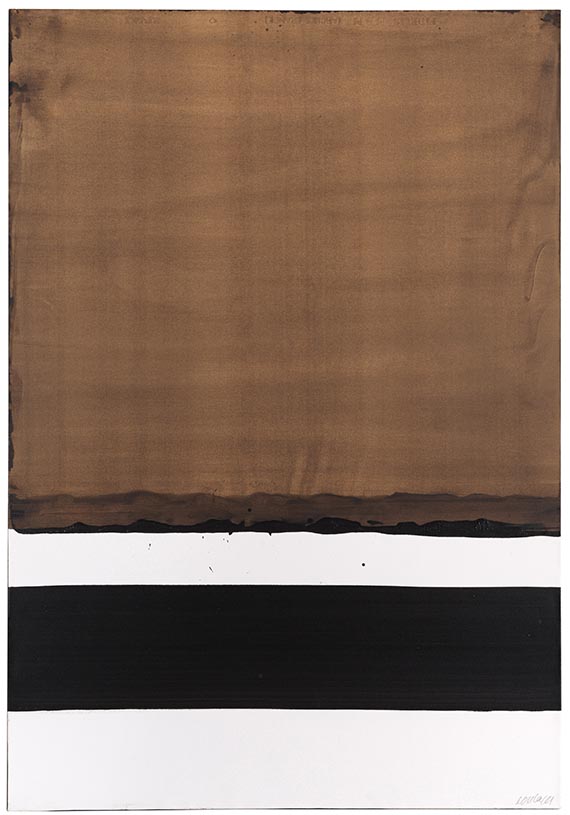 Pierre Soulages
 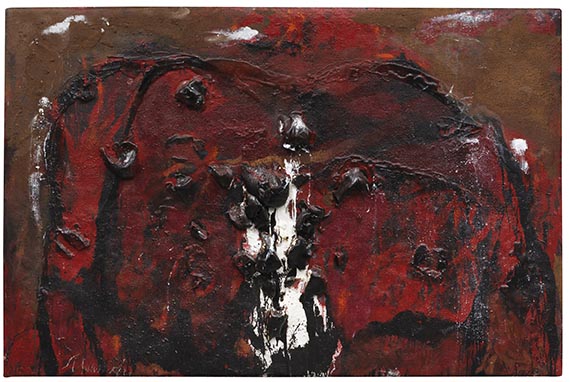 Emil Schumacher
  Arnulf Rainer
  Anselm Kiefer